

All About Vitamin D and Why It's So Important for Us!
The Nutrients
The most important nutrients are divided into two groups: macronutrients (carbohydrates, fats, and proteins) and micronutrients (minerals, vitamins, trace elements, and secondary plant compounds).
Vitamins
Vitamins are essential for the body, meaning it cannot produce them itself (with the exception of vitamin D). The body relies on a sufficient intake of vitamins to maintain vital bodily functions and performance. Vitamins are divided into fat-soluble (vitamin A, vitamin D, vitamin E, and vitamin K) and water-soluble vitamins (all B vitamins, vitamin C). Fat-soluble vitamins can only be absorbed by the body in conjunction with fats (for example, one drop of oil), while water-soluble vitamins can be absorbed by the body even without fats.
What Is Vitamin D?
Vitamin D is a fat-soluble vitamin that the body can store especially in fat and muscle tissue and in the liver. In fact, it is not a classical vitamin. Vitamin D is unique among vitamins because, unlike all others, the body can produce it itself with the help of sunlight (through the action of UV-B radiation). For this reason, vitamin D is a prohormone. But why is it then called a vitamin? Historically, it was first identified as an essential substance that must be taken in through food. Only later was it discovered that the human body can produce it itself.
Various factors, such as geographical location, seasons, and spending a lot of time indoors, negatively affect vitamin D production in the body.
Are We Well Supplied with Vitamin D?
In our latitudes, where the sun does not shine year-round, this can lead to a significant deficiency in vitamin D. According to the vitamin D status for Germany published by the Robert Koch Institute, not even 40% of all adults are sufficiently supplied with the sunshine vitamin.1
A balanced diet in young years is an important prerequisite for child development. The eating habits of children and adolescents aged 6 to 17 years in Germany were examined in depth as part of the EsKiMo II nutrition study. According to this study, which has already been conducted twice, the proportion of children and adolescents who meet the recommendation for vitamin D is very low at both survey points, with < 2%.
Why Is the "Sunshine Vitamin" So Important?
Vitamin D plays a key role in a variety of bodily functions – from supporting the immune system2 to bone mineralization4 and cell division6.
Vitamin D can also play a major role in children.
Immune system: Vitamin D supports the immune system in children and thus contributes to regulating the body's own defense reactions.3
Bones and teeth: Vitamin D supports calcium absorption in the intestine4, which is necessary for the normal mineralization of bones5 and teeth6 in children.
Muscles: Vitamin D3 contributes to the maintenance of normal muscle function.
Cell division: Vitamin D3 ensures normal cell division processes.
Vitamin D Requirements by Age
There are no exact figures on how much vitamin D is needed per day. Experts are still debating how much vitamin D a person actually needs per day – there is still no consensus.
The DGE (German Nutrition Society) has so far established estimated values for an adequate vitamin D intake in the absence of endogenous synthesis (when no conversion of vitamin D through the skin takes place).
|
Age |
Vitamin D in the Absence of Endogenous Synthesis µg/day |
|
Infants (0 to under 12 months) |
10 µg (400 I.U.) |
|
Children (1 to under 15 years) |
20 µg (800 I.U.) |
|
Adolescents and Adults (15 to under 65 years) |
20 µg (800 I.U.) |
|
Adults (65 years and older) |
20 µg (800 I.U.) |
|
Pregnant Women |
20 µg (800 I.U.) |
|
Women Who Are Breastfeeding |
20 µg (800 I.U.) |
|
1 µg = 40 International Units (I.U.); 1 I.U. = 0.025 µg |
|
Since vitamin D intake through diet is very limited and not sufficient to cover the desired supply if enough endogenous production with the help of sunlight cannot be ensured, the DGE clearly recommends taking a vitamin D supplement.8
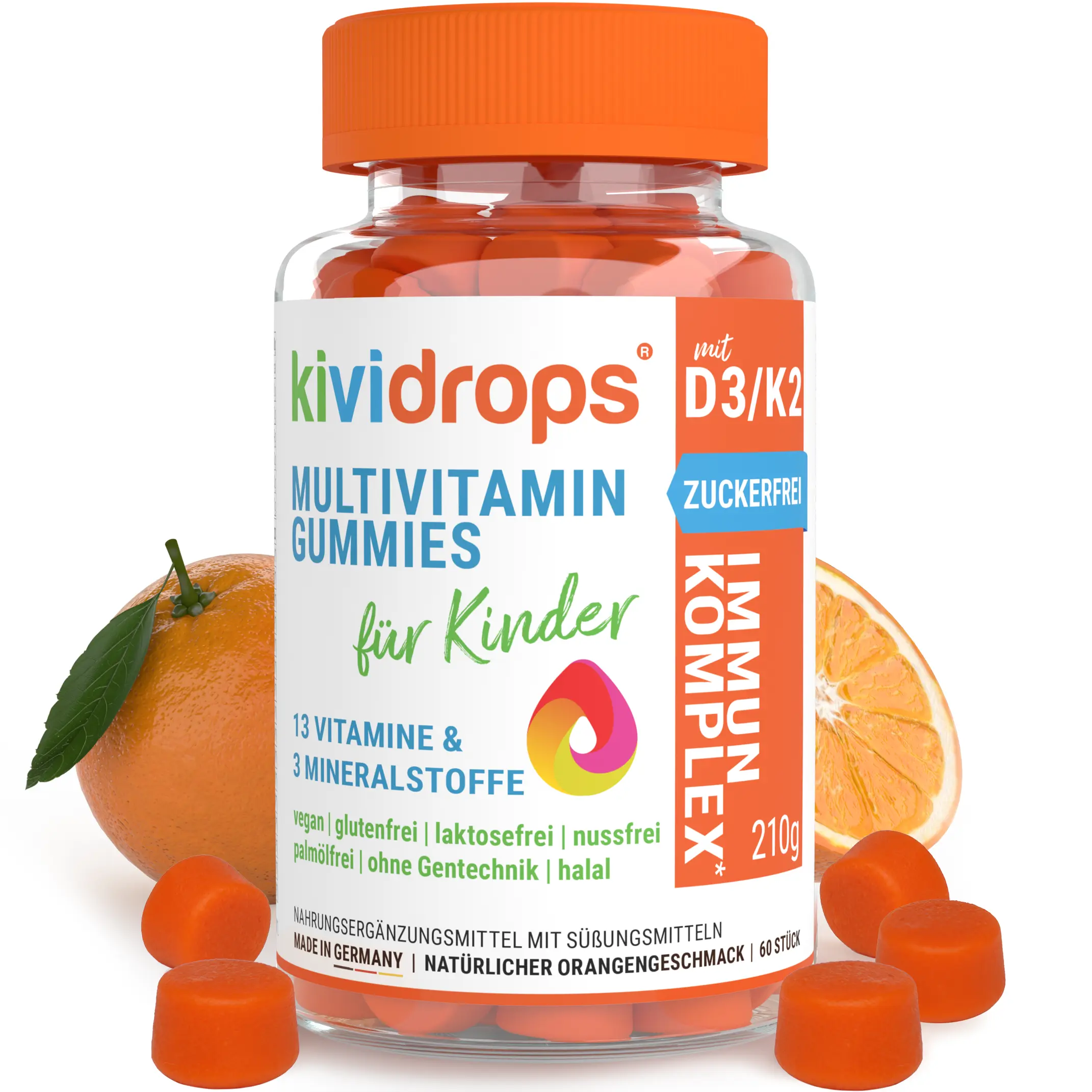
kividrops Multivitamin Gummies – Ideal for covering the daily requirement of Vitamin D3.
The kividrops Multivitamin Gummies contain, in addition to all other important vitamins, 400 IU of Vitamin D3 per drop. This allows dosing exactly as needed without causing an overdose. Sugar-free Multivitamin Gummies have never been so easy and delicious!
Sources:
- RKI (2016): Vitamin D Status in Germany – Journal of Health Monitoring, DOI 10.17886/RKI-GBE-2016-036 (https://www.rki.de)
- https://edoc.rki.de/bitstream/handle/176904/6887.2/EsKiMoII_Projektbericht.pdf?sequence=3&isAllowed=y page 79
- Vitamin D3 contributes to the normal function of the immune system in children
- Vitamin D3 contributes to the normal absorption/utilization of calcium and phosphorus
- Vitamin D is needed for the normal growth and development of bones in children
- Vitamin D3 contributes to the maintenance of normal teeth
- Vitamin D3 has a function in cell division
- dge.de (2012): Vitamin D (https://www.dge.de/wissenschaft/referenzwerte/vitamin-d/)